

The Hidden Cost of Success
You’ve done the hard part. You’ve found product-market fit, landed the enterprise client, and doubled your headcount in a year. Revenue is soaring. But beneath the surface, a different story is unfolding.
The spreadsheet that once tracked inventory is now riddled with errors. The “tribal knowledge” about your key software lives only in the head of one manager who is about to go on leave. Approvals for critical purchases are scattered across WhatsApp chats and old emails.
This is the Growth Paradox: As your business scales, the very systems that fueled your growth begin to buckle under the weight of complexity. You are experiencing a crisis of operational stability. If this sounds familiar, you are not alone—and it is not a technology problem. It is an ownership problem.
The Illusion of Control
When a business is small, agility is its superpower. Processes are informal, communication is direct, and everyone knows “how we do things here.” But growth shatters this illusion.
Growth introduces:
Specialization: People focus on narrower roles and lose sight of the whole picture.
Complexity: A single CRM is now integrated with an ERP, a marketing automation tool, and a customer support desk.
Distance: The founder or CEO is no longer in every room where decisions are made.
Without a deliberate shift in mindset, digital operations become chaotic. The business is no longer running the systems; the systems are running (and tripping up) the business. This is the moment where risk management becomes not just an IT concern, but a boardroom imperative.
(The “Growth vs. Control” Diagram)
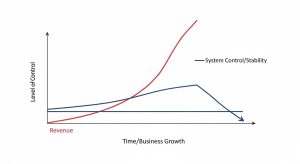 [Visual Suggestion: A simple line graph. The X-axis is “Time/Business Growth.” The Y-axis is “Level of Control.” One line (Revenue) shoots up exponentially. The other line (System Control/Stability) rises slowly, then plateaus, and finally drops sharply.]
To understand how you lose control, you have to map the journey. Most businesses pass through four distinct stages:
Stage 1: The Startup Scramble (High Control, Low Complexity)
In the beginning, one person—often the founder—holds all the keys. They know the password to every account, the logic behind every spreadsheet, and the contact for every vendor. Control is absolute, but the system is fragile because it relies entirely on one individual.Stage 2: The Functional Fix (Adding Tools)
As the team grows, departments buy their own tools to solve immediate problems. Marketing buys a new analytics tool. Sales buys a dialer. Operations builds a new Excel macro. This “Shadow IT” solves short-term pain but creates long-term integration headaches. No one is managing the corporate IT architecture as a whole.Stage 3: The Communication Breakdown (Informal Processes)
With tools proliferating, communication becomes the glue holding everything together. But the glue is weak. Processes live in WhatsApp messages, verbal instructions, and unshared documents. When someone is sick or leaves, the knowledge leaves with them. This is the point where business continuity is at its highest risk.Stage 4: The Stability Crisis (The Drop)
Something breaks. A key system crashes, a client invoice is lost, or you fail a compliance audit because you can’t produce an audit trail for a financial decision. The lack of formal governance is now a tangible business liability. Growth stalls, not because you can’t find customers, but because you can’t reliably serve the ones you have.
Why “System Ownership” is the Missing Link
When we ask business leaders why they lost control, they often blame the software. “The ERP is too clunky.” “The CRM is too limited.” But the software is rarely the root cause.
The root cause is a lack of system ownership.
System ownership is different from system administration.
An administrator resets passwords and updates software.
An owner is accountable for the system’s performance, its strategic alignment with the business, its security posture, and its lifecycle.
In a growing business, every critical system—from your accounting platform to your project management tool—needs a named owner. This person (or team) is responsible for:
Governance: Ensuring data integrity and process compliance.
Lifecycle Management: Knowing when the system needs an upgrade, an integration, or a replacement.
Risk Mitigation: Identifying single points of failure and ensuring business continuity.
Value Realization: Making sure the business is actually getting the ROI it expected from the tool.
Without this ownership layer, you are not managing your digital operations; you are simply reacting to fires.
Bridging the Management Gap
So, how do you bridge the gap between the chaos of informal growth and the stability of a mature organization? You cannot simply “go back” to the way things were. You must build a new framework for control.
This requires shifting your mindset from reactive firefighting to proactive governance. It means documenting processes, centralizing knowledge, and, most importantly, assigning accountability.
For many mid-sized businesses, hiring a full-time, senior “Head of Systems” or building out an internal governance team feels too expensive or too slow. This is where the concept of an extended team comes into play. You need a partner who can provide the expertise and accountability of a system owner, without the overhead of a full-time hire.
Conclusion: From Chaos to Clarity
Losing control of your systems is not a sign of failure; it is a sign of growth. The question is whether you will let that growth turn into chaos. By understanding the “Growth Paradox” and the four stages of system decay, you can recognize the warning signs early.
The path to operational stability lies in formalizing system ownership. It is the strategic layer that ensures your technology serves your business goals, rather than undermining them.
Ready to move from reactive chaos to proactive control? At Softlink Option, we specialize in providing the governance and system ownership that growing businesses need to scale with confidence.
Ready to Regain Control of Your Business Systems?
As your business grows, your systems should grow with it. Softlink Options can help you streamline your processes, strengthen system management, and build a more scalable technology foundation. Contact us today to find the right solutions for your growing business.
Ready to Take Control of Your Business Systems?
Scaling your business should create new opportunities—not more confusion, inefficiencies, and disconnected systems. Softlink Options LTD helps growing businesses streamline their operations, improve system integration, and build reliable digital solutions that support sustainable growth. If your business is struggling to keep up as it scales, now is the time to take control of your systems and prepare for the next stage of growth.